
Introduction
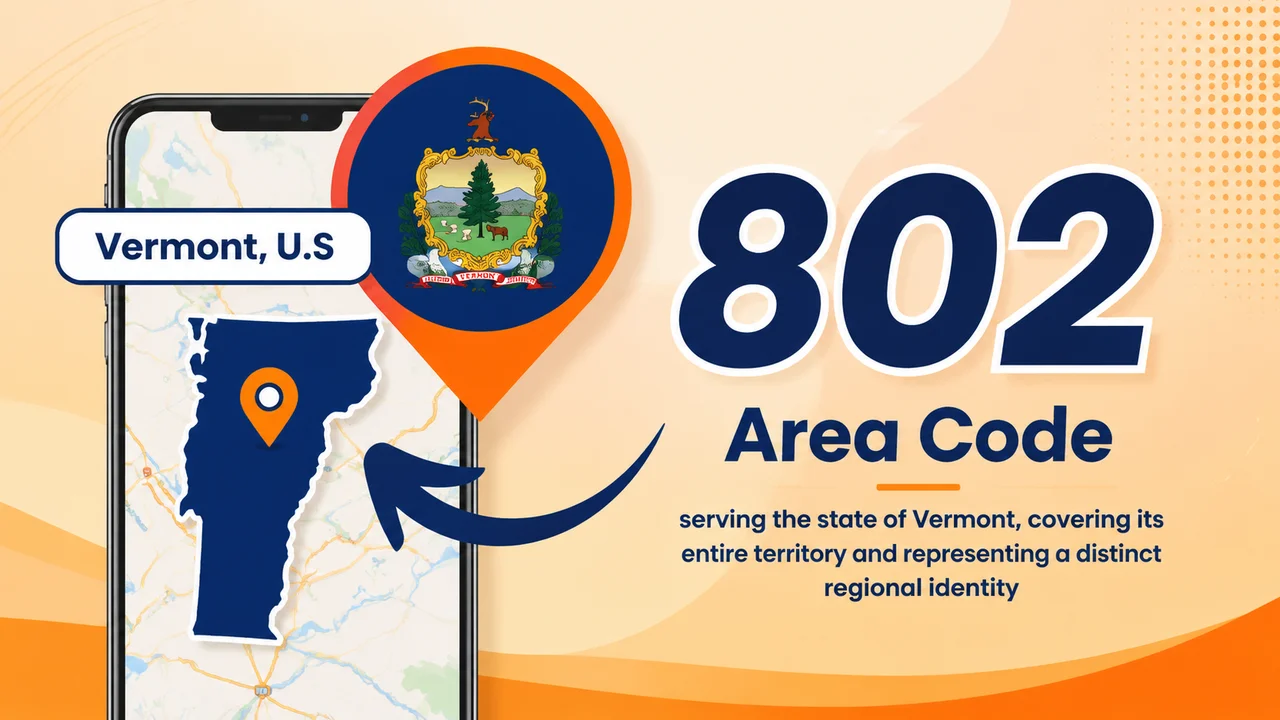
Vermont is one of the last states in the country with a single area code. One code. The whole state. While Texas juggles 28 and California burns through new prefixes every couple of years, the 802 area code has covered every Vermonter — from Burlington to Brattleboro — since Harry Truman was in office. That scarcity is the whole story. When a 645,000-person state shares one code, locals notice the number on their screen. An 802 prefix reads as "neighbor." A 312 or 800 reads as "ignore." Here's what that means for your business — and how scammers exploit the exact same instinct.
letsdial products introduced in this guide
What is the 802 area code?
The 802 area code is the telephone area code covering the entire state of Vermont. It was assigned in October 1947 as one of the original North American Numbering Plan (NANP) codes, and it has never been split or overlaid — making it the sole code for all 14 Vermont counties.
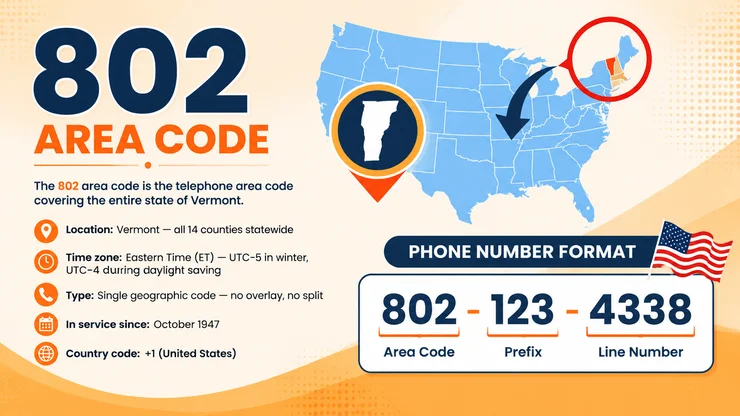
That makes Vermont rare. Only about 11 states still run on a single area code — Wyoming's 307 area code is another — and 802 is the one most tied to local identity. When someone sees an 802 number on their screen, they read it as a genuine Vermont line before the call even connects.
One state, one code: why 802 is different
Most area codes tell you a city. 802 tells you a state, a culture, and a 78-year history all at once.
It's older than most phone numbers you've dialed
802 was part of the first batch of NANP codes the FCC and AT&T mapped out in 1947. Vermont received one code because its call volume fit inside one — and it still does today.
No overlay, no split, no confusion
Big metros pile a second or third code on top of the first (an "overlay"), forcing ten-digit dialing and diluting local meaning. Vermont never needed one. According to NANPA, 802 has zero overlays — a single, clean code for the whole state.
802 became a brand
Walk through Burlington and you'll see "802" on hats, beer cans, and bumper stickers. The code turned into shorthand for the state itself. No other area code carries that kind of civic pride — and that pride is exactly why a local number converts. Locals don't just recognize 802; they trust it.
Where is the 802 area code located?
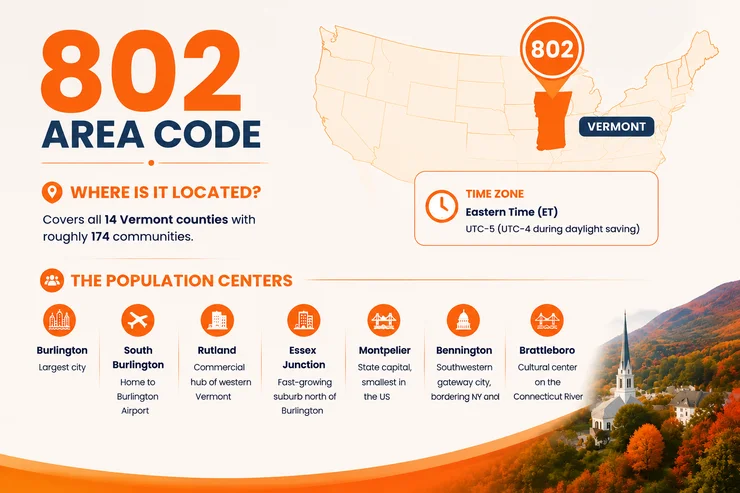
Area code 802 spans roughly 174 communities across all 14 Vermont counties, sitting entirely in the Eastern Time zone (UTC-5, or UTC-4 during daylight saving).
The population centers
- Burlington — the largest city, anchored by the University of Vermont and UVM Medical Center
- South Burlington — the state's second-most-populous city and home to Burlington International Airport
- Rutland — the commercial hub of western Vermont
- Essex Junction — a fast-growing suburb north of Burlington
- Montpelier — the state capital, the smallest state capital by population in the US
- Bennington — the southwestern gateway city, bordering New York and Massachusetts
- Brattleboro — the cultural center of southern Vermont, on the Connecticut River
The economy behind the calls
Vermont isn't just ski lodges. GlobalFoundries runs a major semiconductor plant in Essex Junction; Casella Waste Systems is headquartered in Rutland; and healthcare, higher education, tourism, and agriculture drive steady B2B and B2C call traffic every day. An 802 number gives you a foot in all of it.
Why a local 802 number carries extra weight
In a one-code state, the area code is a tribal marker. Vermonters answer 802 because it almost always means someone they might actually know — a clinic, a contractor, the school.
Local numbers get answered more
Buyers across the board pick up local numbers far more often than toll-free or out-of-state lines. In a tight-knit market like Vermont, that gap widens. The number itself is a foot in the door before you say a word.
It signals you're actually here
A national company calling a Vermont small business from a local line reads as committed, not transactional. That perception shapes whether the first 10 seconds of the call go anywhere — and whether there's a second call at all.
letsdial products for Vermont businesses
The spoofing problem — and why it's your problem too
Every reason an 802 number builds trust is a reason a scammer wants to fake one. Caller ID spoofing lets a bad actor display any number they want — including a fresh-looking 802 one. Because Vermonters trust the code, spoofed calls land.
"Neighbor spoofing" is the worst of it
Scammers spoof a number that matches the first several digits of the recipient's own number, so it looks like a true local. It's effective, it's illegal, and it's burning trust in the one signal honest Vermont businesses rely on. Every spoofed robocall trains Vermonters to screen unknown local numbers — including yours.
That's why how you originate your calls now matters as much as the number you display. A number that isn't properly signed looks identical to a spoofed one on the recipient's screen.
How to get an 802 number for your business
You don't need a Vermont office to get a Vermont number. A cloud phone platform assigns you a local 802 DID and routes calls to any device, anywhere. With letsdial, the process takes under three minutes — no hardware, no carrier contract, no long-term commitment.
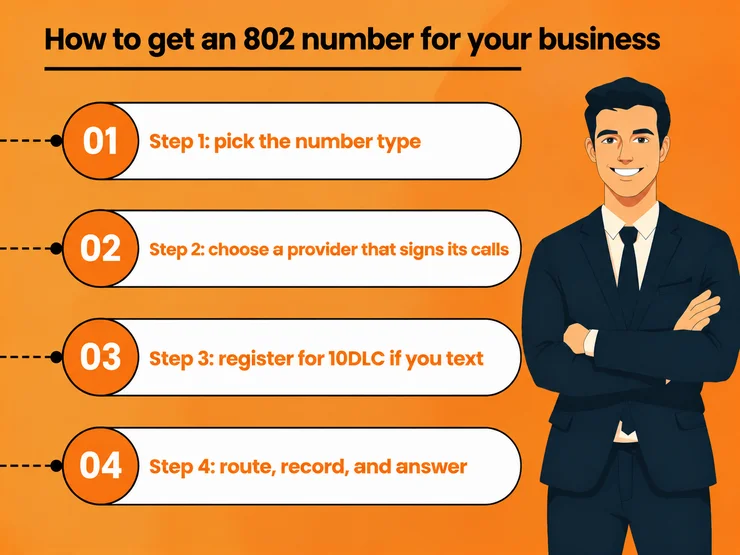
Step 1: pick the number type
Decide between a fresh local 802 DID for outbound presence, or porting an existing Vermont number you already advertise. Porting keeps your brand equity intact — and letsdial ports numbers in free, both directions.
Step 2: choose a provider that signs its calls
This is the step most guides skip. Your provider should sign every call with STIR/SHAKEN attestation so carriers — and Vermonters — see your call as verified, not spoofed. letsdial routes voice on Tier-1 backbones with A-level STIR/SHAKEN attestation at the switch.
Step 3: register for 10DLC if you text
If you'll send business SMS from the line, 10DLC registration tells carriers your messages are legitimate. Skip it and your texts get filtered before they arrive. letsdial files 10DLC registration for you — it's handled, not an add-on.
Step 4: route, record, and answer
Point the number at your team's app, a desk phone, or an AI Receptionist for after-hours coverage. letsdial's AI Receptionist answers, qualifies, books, and writes the CRM note when no one's free — so no Vermont call is ever lost to voicemail again.
Explore letsdial voice & messaging
Keeping your 802 number out of the spam bucket
Getting the number is easy. Keeping it out of the "Spam Likely" label takes a few deliberate moves.
Sign every call
Carriers now label unsigned calls. Platforms carrying A-level STIR/SHAKEN attestation at the switch — like letsdial's Tier-1 routes — give your calls the cleanest possible label from the moment they leave your platform.
Don't burn the number
Blasting 300 calls an hour from one new DID is the fastest way to get it flagged. Warm up new numbers gradually, keep answer rates healthy, and rotate sensibly across your DID pool.
Make the number recognizable
Consistency helps. Use the same 802 line on your website, email signature, and Google Business Profile so the number builds its own call reputation over time. A number that shows up consistently in the right places earns trust with carriers the same way it earns trust with people.
Conclusion
The 802 area code isn't just a routing detail — in Vermont it's a trust signal that still works, precisely because the state never split into a dozen codes. One code, one state, 78 years of local credibility. The opportunity is real, and so is the spoofing problem slowly eroding it.
Conclusion
If you sell into Vermont, get a local 802 number, sign your calls properly, and treat your caller ID like the asset it is. You'll get answered more — and you won't get mistaken for the scammer sending robocalls down the road.
Get your 802 number today
Frequently Asked Questions
Written by Aryan Khan · June 13, 2026
Reply to the author