
Introduction
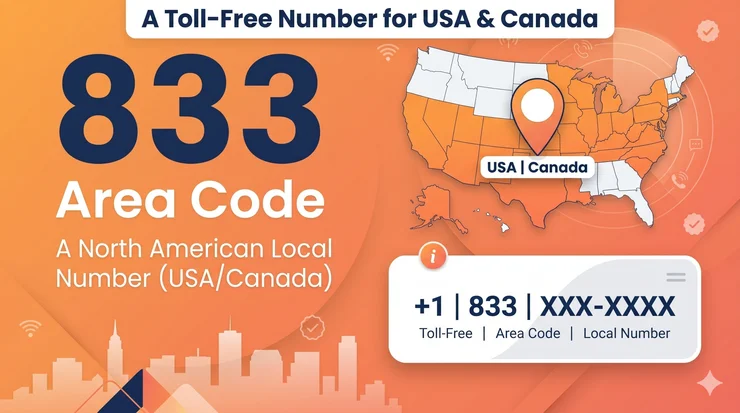
Search the 833 area code expecting a city and you'll hit a wall. There isn't one. 833 isn't a place — it's a toll-free code that rings the same whether the caller is in Miami or Montana. That makes it the odd one out in our area code series: every other code maps to a region, but 833 maps to a billing model. Below is what it actually is, when it beats a local line, and how to get one.
letsdial products introduced in this guide
Why 833 has no hometown
Born from a number shortage
833 launched on June 3, 2017 when the older toll-free codes ran low. Demand was so high the FCC opened it to give businesses a fresh pool — including the vanity numbers the 800 range exhausted decades ago.
The toll-free family
800 came first, then 888, 877, 866, 855, 844, and now 833 — all administered through Somos, the toll-free registry. They're interchangeable in function; an 833 works exactly like an 800.
The caller pays nothing
That's the whole point of a toll-free number: the business covers the cost of every inbound call, so customers dial without a second thought about charges.
It routes anywhere you want
Because there's no fixed location, a toll-free line can ring a call center in one state today and a remote team in another tomorrow. The number stays the same no matter where the calls actually land.
Toll-free or local: which does your business actually need?
When 833 wins
Going national, running one line across many states, or want a memorable vanity number? Toll-free shines. It says 'established company' and gives callers one number to remember everywhere.
When a local number wins
Serving one city or region? A local code often gets answered more — people pick up neighbors faster than 800-style numbers. For field services and regional sales, local usually beats toll-free on pickup.
Why plenty of teams run both
Many businesses publish a toll-free 833 for national credibility and route local numbers for regional campaigns — one platform, both kinds of line.
Vanity is 833's real edge
The 800 range ran out of good spellable numbers ages ago. 833 reopened that game — so a clean 1-833-YOUR-BRAND is often still available where an 800 version never will be.
The catch: toll-free isn't automatically trusted anymore
Scammers use toll-free too
Robocallers and 'is this a scam?' searches cluster around toll-free codes, including 833. A toll-free prefix alone no longer signals legitimacy the way it did in 1995.
What actually earns the pickup
Trust now comes from how the call is presented — STIR/SHAKEN attestation and a displayed business name matter more than the prefix. Sign your outbound calls and brand the caller ID, toll-free or not.
Inbound is where toll-free still shines
The trust gap mostly hurts outbound dialing. For inbound — a number on your website, ad, or package that customers choose to call — an 833 still does its original job well: one easy, free, memorable line.
How to get an 833 number
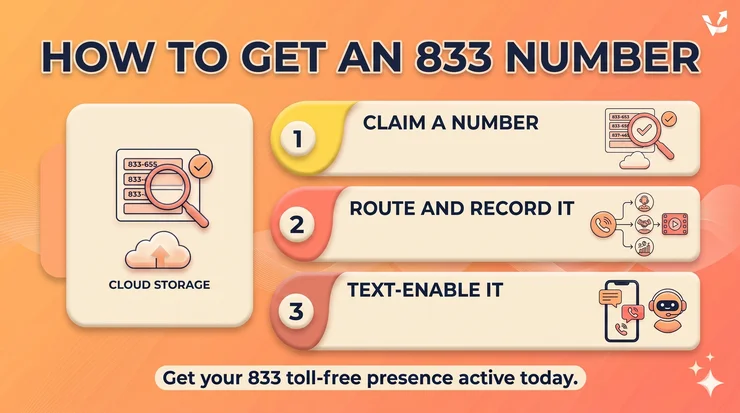
- Claim a number — and grab a vanity if you can. Pick an available 833, ideally one that spells your brand. [letsdial](/products/business-phone) provisions toll-free and local numbers from one [cloud phone setup](/products/business-phone).
- Route it and record it — send the 833 to the right team with intent routing, and capture every call. A [contact center](/products/contact-center) that routes by intent turns one national number into the right answer for each caller.
- Text-enable it — customers text businesses now, and 833 numbers can be made textable with verification. Pair it with an [AI Receptionist](/products/ai) so calls and texts to your toll-free line both get a fast answer.
The bottom line on 833
The 833 area code is a national toll-free code, not a city — useful when you want one memorable line everywhere and a shot at a clean vanity number. Just don't expect the prefix alone to earn trust. Sign your calls, brand the caller ID, and decide honestly whether national toll-free or a local number fits how your customers actually buy.
Get your 833 number today
Frequently Asked Questions
Written by Aryan Khan · June 18, 2026
Reply to the author