
Introduction
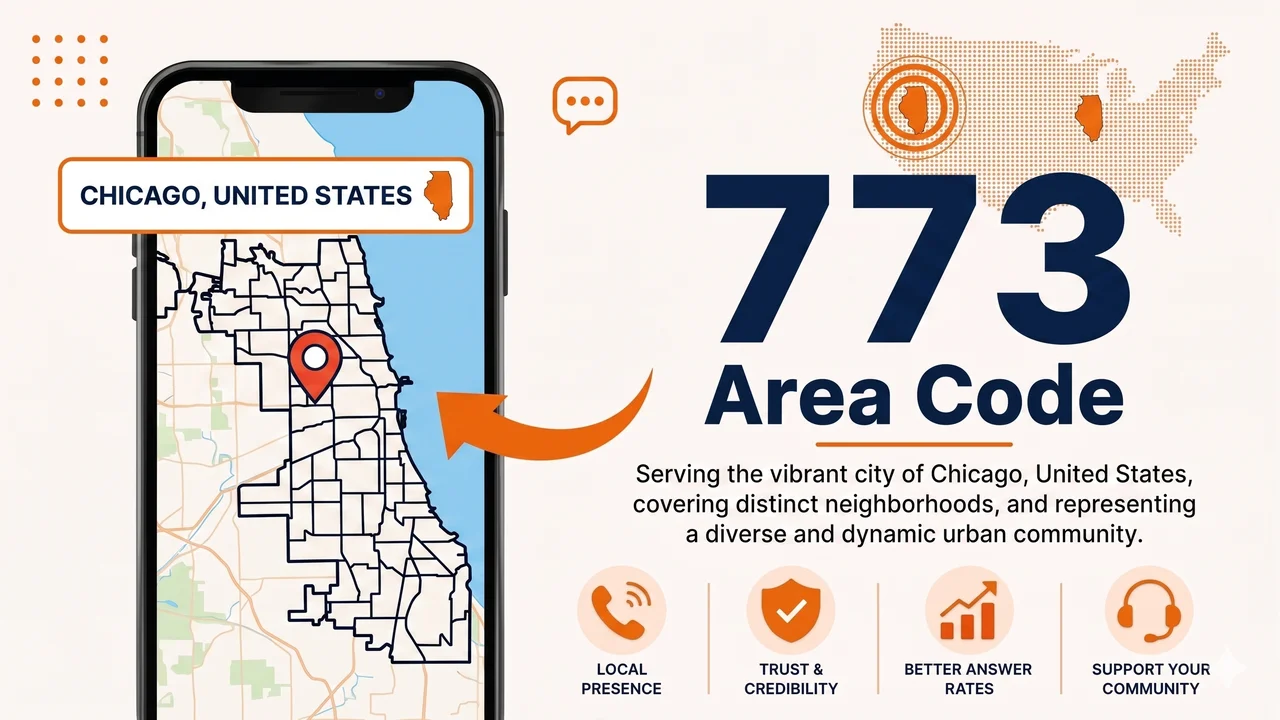
In Chicago, your area code is a postcode for your identity. 312 is the downtown core — the Loop, Michigan Avenue, River North. 773 is everything else: the North Side, South Side, West Side, and every neighbourhood in between. The city limits are the boundary. Cross into the suburbs and you're in 708 or 630 territory. Stay inside and you're on 773.
That geography makes 773 one of the most legible local codes in the country. It doesn't say "greater metro area" — it says Chicago, specifically. For a business that wants to signal city presence without claiming the premium downtown 312, it's the honest signal. Here's the history, the overlay, the scams, and how to run a 773 that actually gets answered.
How 773 Split From 312 in 1996
312 was Chicago's original code — assigned in 1947 as one of the first area codes in the country, covering the entire city and its suburbs. By the mid-1990s, fax machines, pagers, and mobile phones had drained the pool.
The 1996 Split
On October 12, 1996, Chicago split along the city-suburb line. 312 kept the central business district — the Loop and immediate downtown. 773 took the rest of the city: all 77 community areas outside that core.
The Suburbs Got Their Own
The suburbs had already been separated earlier — 708 split from 312 in 1989 to cover the collar counties. After 1996, the Chicago metro had a three-way structure: 312 downtown, 773 the city neighbourhoods, 708 and 630 the suburbs.
Then Came 872
By 2009, 773 needed relief. 872 was overlaid across the entire city — the same geography as both 312 and 773 — making ten-digit dialing mandatory for all Chicago calls. New lines in the city can come as 312, 773, or 872.
What 773 Covers
773 is Chicago's neighbourhoods — the residential and commercial fabric of the city outside the Loop.
North Side
Lincoln Park, Lakeview, Wrigleyville, Andersonville, Rogers Park, Edgewater, and Uptown — the densely populated lakefront neighbourhoods running north from downtown.
West Side
Wicker Park, Bucktown, Logan Square, Humboldt Park, Austin, and Oak Park-adjacent communities — the city's most rapidly changing commercial corridor.
South Side
Hyde Park, Bridgeport, Pilsen, Bronzeville, Chatham, and Englewood — home to the University of Chicago and a broad swathe of the city's historic communities.
312 vs 773 vs 872: Which Chicago Code Fits?
With three codes covering the same city, the choice carries real positioning weight.
312 Says Downtown
312 is the Loop, LaSalle Street, Mag Mile — the original Chicago code. It carries prestige and signals a central-business-district presence. Inventory is tight, which is why 312 numbers command a premium and why businesses outside the CBD often can't get one anyway.
773 Says the City
For a neighbourhood business, a restaurant, a clinic, a contractor, or a service company operating across Chicago's residential communities, 773 is the honest code. It says city without overstating downtown.
872 Is Neutral
872 is the newest overlay and has no neighbourhood connotation yet — it reads as a Chicago number but without the geographic specificity of 312 or 773. Fine for a new business with no legacy equity in either older code.
The Spam Problem Wearing a 773 Area Code
Chicago's density and 773's neighbourhood recognition make it a useful cover for fraud.
Common Schemes
Auto-warranty robocalls and fake debt-collection calls dominate 773 spam complaints, followed by Medicare/Medicaid pitches and IRS impersonation. Chicago residents report a high volume of calls per month — the density of the metro makes it a productive target.
Neighbour Spoofing
Fraudsters spoof 773 numbers that match a Chicago recipient's own prefix, so the call looks like it's coming from the same neighbourhood. The FCC has flagged this tactic repeatedly. The displayed number is almost always fake.
What It Costs Legitimate Callers
Every spoofed call trains Chicago residents to be sceptical of unknown 773 numbers. Authentication — STIR/SHAKEN at the carrier level — is the practical separation between your call and the noise.
How to Get and Run a 773 Number
You don't need a Chicago office to ring as a Chicago neighbourhood business. You do need to handle the spam environment.
- Claim or port — grab available 773 inventory, or port the 773 line you've already built a reputation on. [letsdial](/products/business-phone) ports numbers in and out free, no lock-in.
- Sign every call — use a provider with STIR/SHAKEN attestation at the carrier level. In a high-volume spam metro, an unsigned call is a liability.
- Register 10DLC for texting — Chicago businesses texting customers need [10DLC registration](/products/sms-mms) to clear carrier filters. A capable platform handles the filing.
Final Read
773 is one of the most legible local codes in the country — it says Chicago's neighbourhoods, plainly and specifically. The overlay stack (312, 773, 872) gives businesses a real positioning choice, and 773 is the right call for anyone operating in the city outside the Loop.
Pick the code that matches your Chicago footprint, authenticate every call you place, and put an AI receptionist on the line that answers. In a dense, competitive market like Chicago, local credibility is earned on every call.
Get a Chicago 773 number
Written by Tyler Brennan · Jun 13, 2026
Reply to the author