
Introduction
Every wholesale voice provider calls itself carrier-grade. The phrase has been used so heavily in marketing that it now means almost nothing on its own.
Buyers are left squinting at rate decks and uptime claims that all sound interchangeable, while the underlying differences are exactly what decide whether your wholesale voice traffic stays profitable a year from now.
This piece unpacks what carrier-grade should actually mean in wholesale voice termination, across the five places where the marketing line either matches reality or quietly falls apart once traffic goes live: tiers, CLI, the SIP path, monitoring, and failover.
Tier 1, Tier 2, Tier 3, what the labels actually mean
The cleanest framework for thinking about a wholesale voice provider is the tier system the industry has used for decades. Each tier represents a different kind of relationship with the underlying network.
- Tier 1: carriers that own physical backbone infrastructure and peer directly with other Tier 1s. Lowest post-dial latency, premium CLI, the highest answer rates.
- Tier 2: providers that buy capacity from Tier 1s and blend it intelligently. Good economics with most of the quality intact.
- Tier 3: aggregators of cheap capacity for bulk traffic where caller ID is not required. Best for outbound campaigns.
For wholesale voice termination, the question is not which tier is best in absolute terms, but which tier each segment of your traffic deserves.
Enterprise and contact-centre outbound need Tier 1. High-volume campaigns can sit on Tier 3. A good wholesale voice provider lets you mix tiers per destination rather than forcing everything onto one blended pool.
If a provider claims Tier 1 across the board, ask which routes specifically, and whether they will share the underlying carrier identities. Vague answers usually mean traffic is blended through cheaper pools while the Tier 1 label stays in the marketing.
Why CLI delivery decides answer rates
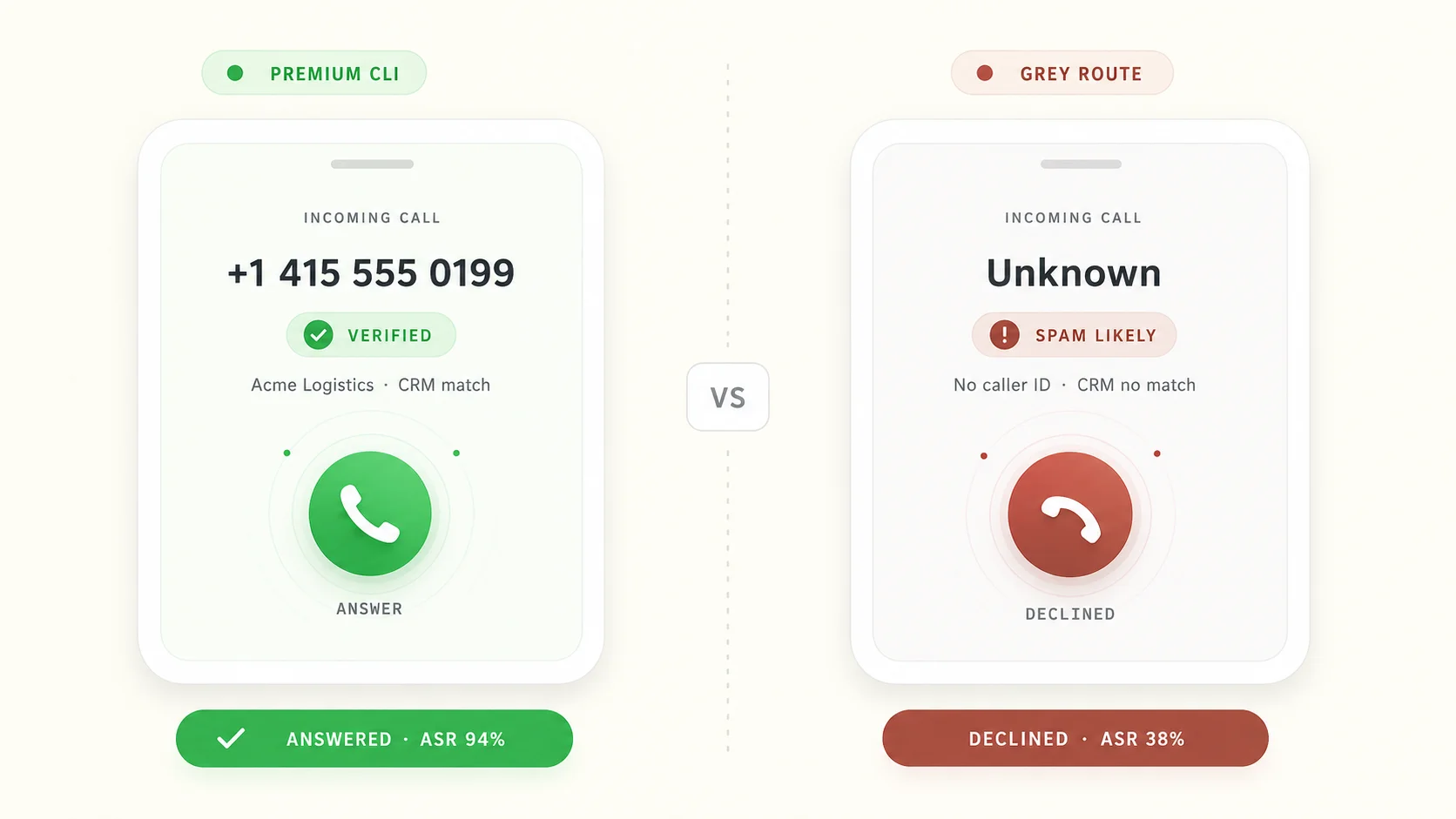
Caller ID, or CLI, is the number that appears on the recipient's phone before they pick up. On a clean wholesale voice route the CLI passes through every intermediate carrier exactly as you set it.
On a grey route, intermediate carriers strip or rewrite the CLI. The recipient sees a different number or no caller ID at all, and modern phones flag the call as Spam Likely and decline it automatically.
A campaign sending 100,000 calls a day through a grey route can lose 20 to 40 points of answer rate compared with the same campaign on a premium CLI route. Across a month, the savings on the cheaper route are usually wiped out many times over.
Before signing with any wholesale voice provider, ask three questions:
- Which specific routes guarantee CLI end to end, and which do not?
- What is the answer-seizure ratio on those routes against grey-route alternatives?
- Where do I see those numbers live, without filing a ticket?
The signal path that carries every call
Every voice call placed across a wholesale voice network rides on a small choreography of SIP messages and an RTP media stream. SIP handles the signalling. RTP carries the audio packets once the call is up.
Both have to work cleanly for a route to qualify as carrier-grade in any honest sense. The operational details that decide quality in production are:
- SIP header preservation across every hop on the path.
- Response time on 100 Trying and 180 Ringing under load.
- Clean handling of edge cases like early media and SIP REFER.
- RTP jitter, packet loss tolerance, and consistent codec negotiation.
Ask a wholesale voice provider how they preserve SIP headers, which codecs they negotiate by default, and what their median RTP jitter looks like across the backbone. Specific, confident answers signal a real engineering team. Redirection to a marketing one-pager signals the opposite.
Real-time monitoring and a NOC that answers
A carrier-grade wholesale voice service is not a thing you buy and forget. It is a relationship maintained, in real time, by people who know what your traffic should look like and act when it stops looking like that.
Platform uptime is the headline number. The operational signals that matter more in day-to-day wholesale voice are:
- Per-route answer-seizure ratio (ASR), tracked by destination.
- Post-dial delay distribution, not just the average.
- Mean opinion score (MOS) trends on premium routes.
- Sudden changes in jitter or packet loss on specific carriers.
Expect a portal that exposes those signals in close to real time so your team can corroborate them against your own call detail records. Expect, too, that the first message about an incident comes from the provider, not from your largest customer.
Failover, the way it should actually work
Failover is where the carrier-grade label is either true or merely printed on a slide. In a real wholesale voice network, when a primary route degrades below a quality threshold, traffic is automatically re-routed through a backup route within fractions of a second.
The decision is made by the routing engine, not by a human watching a dashboard. Three questions tell you whether the engine is real or only a process:
- How is failover triggered, automatically by metric thresholds, or by a human?
- How long does it take from threshold breach to backup route active?
- Can I test it during a paid trial by dropping a backbone link in a controlled window?
A confident answer with specific timing tells you the engine is real. A vague answer tells you it is a process, which is not the same thing as a system.
The bottom line
Carrier-grade in wholesale voice is not about marketing language. It is about everyday operational details: which tiers carry your traffic, how cleanly CLI passes through, how the SIP path is engineered, how the NOC reacts when something dips, and how quickly failover lands without anyone noticing.
Conclusion
At letsdial, we built our wholesale voice service around exactly these fundamentals: premium CLI on Tier-1 backbones, a live NOC, automatic failover in fractions of a second, per-second billing without rounding, and a portal that shows the same numbers we see internally.
Written by Daniel Park · May 18, 2026
Reply to the author